
Why go
Fanjingshan (Fan-jing, 'Brahma's pure land') has been a Buddhist mountain since the Ming, and is considered the bodhimaṇḍa of Maitreya, the future Buddha. Its name echoes the Sanskrit sukha-vati — the Pure Land — and its cloud-wrapped summit has drawn pilgrims for centuries.
UNESCO inscribed the mountain in 2018 on natural criteria: it is a biological island where subtropical species survived ice ages, including the endemic Guizhou snub-nosed monkey and the Fanjingshan fir. The vertical zones of vegetation rise from broadleaf forest at the base to rhododendron and fir near the summit.
- Red Clouds Golden Summit — the twin peak connected by a bridge
- Mushroom Stone — the iconic balanced boulder
- Old Golden Summit with its Buddhist temple
- The Guizhou snub-nosed monkey — only found here
Where to go
Take the cable car from the Heiwan River station to the upper area, then climb the stone staircases to the summit cluster. The Red Clouds Golden Summit is the most photographed: two stone pillars linked by a narrow bridge, with temples atop each.
Mushroom Stone, a balanced boulder on the ridge, is the mountain's second icon. Continue to the Old Golden Summit for a wider panorama and the main Buddhist temple.
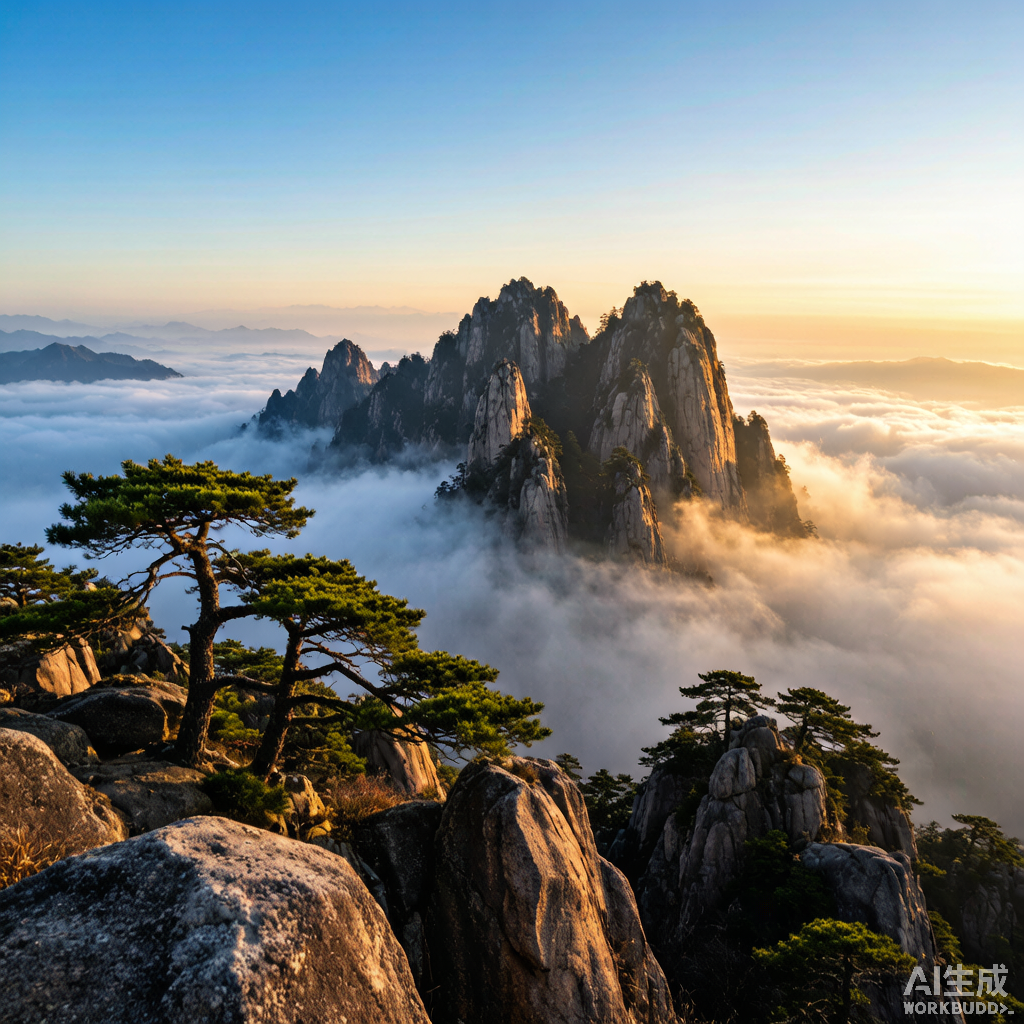
Cloud is the constant element — be patient. When the cloud clears, the view across the Wuling ranges is one of the most dramatic in southern China. The weather changes minute to minute; bring layers.
Practical notes
The daily visitor number is capped — book the ticket in advance, especially on weekends. The stone staircases to the summit are steep and crowded in peak season; pace yourself. Avoid Chinese public holidays.
Getting there
- High-speed train to Tongren, then bus to the park (1 hr)
- Drive from Tongren or Zhenyuan (2 hr)
- Elevation
- 2,572 m
- Endangered species
- Guizhou snub-nosed monkey, Fanjingshan fir
- UNESCO
- World Heritage since 2018