
Why go
Sanqingshan has been a Daoist retreat for over 1,600 years — the three main peaks of Yujing, Yuhua and Yuxu represent the 'Three Pure Ones' of the Daoist trinity. The temples were built into the granite itself, often hidden by cloud and pine.
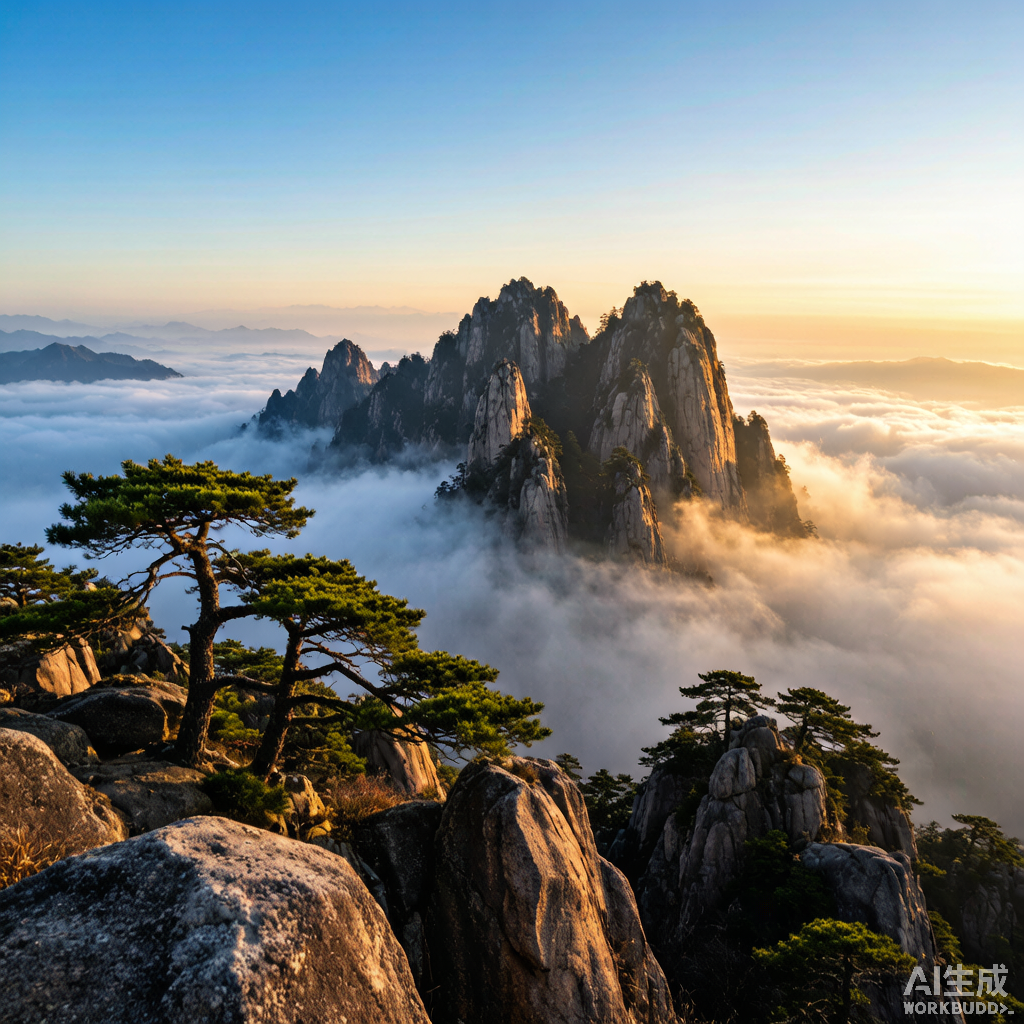
Geologically, the mountain is a forest of granite pillars shaped by hundreds of millions of years of erosion. UNESCO inscribed it in 2008 for both its geology and its role in Daoist culture. The sea of clouds that often fills the valleys makes the peaks appear to float.
- The 'Gigantic Boa' (Jusi) — a 128-metre vertical granite pillar
- The East Coast and West Coast loop trails
- Sanqing Temple — a Daoist temple high on the ridge
- Sunrise from Yujing Peak — the summit at 1,819 m
Where to go
Take the cable car from the Waishuangxi station to the upper area. The main trail is a loop — the East Coast and West Coast paths — that contours around the ridges on boardwalks suspended above steep drops. Allow 4–6 hours for the full loop.
The signature sights are the Gigantic Boa (a slender pillar) and the Oriental Goddess (a pillar shaped like a sitting figure), both on the East Coast path. Continue to Yujing Peak for sunrise if you stay overnight.
Sanqing Temple, perched on the ridge, is the centre of Daoist practice — visit quietly. Sunrise from the summit is the goal of overnighters; a guesthouse sits near the top.
Hiking tips
The boardwalks are well-maintained but exposed — bring wind and rain layers. Cloud changes by the minute; patience at a viewpoint is rewarded. Stay overnight if you want sunrise; the cable car does not run in the dark.
Getting there
- High-speed train to Shangrao, then bus or taxi (1.5 hr)
- Drive from Huangshan or Jingdezhen (2–3 hr)
- Highest peak
- Yujing, 1,819 m
- UNESCO
- World Heritage since 2008
- Tradition
- Daoist sacred mountain